
Professional Education / Transfusion
Learn.Share.Advance
Summary of adverse transfusion reactions 2021-2026
Author: Matthew Yan, MD, FRCPC
Revised: 2026-10-21
According to Blood Regulations, hospitals are required to report adverse transfusion reactions following a transfusion to Canadian Blood Services if the reaction is thought to be caused by a blood component deficiency affecting its safety, and is attributable to a regulated activity at Canadian Blood Services (e.g., donor selection, blood collection, manufacturing).
To learn more about adverse transfusion reactions, please visit Chapter 10 of the Clinical Guide to Transfusion.
How to report adverse transfusion reactions
To facilitate reporting of adverse transfusion reactions, we have prepared A Guide to Reporting Adverse Transfusion Reactions, which includes links to reporting forms.
Which adverse transfusion reactions are reported to Canadian Blood Services
The adverse transfusion reactions data reported to Canadian Blood Services are summarized in the graphs below. It is important to note that only adverse transfusion reactions that are reportable, or were initially deemed to be reportable, to Health Canada by Canadian Blood Services as determined by the Blood Regulations, are included in these graphs. Not included here are adverse reactions reported to Canadian Blood Services that are deemed to be not reportable to Health Canada (e.g., the reaction was minor or unrelated to the transfusion procedure).
Ongoing education with hospital health-care professionals promotes the appropriate reporting of transfusion reactions related to Canadian Blood Services’ components. Those efforts have led to a reduction in the number of adverse transfusion reactions reported to Canadian Blood Services that are related to the patient’s underlying condition (e.g., TACO or febrile reactions) rather than to the component.
Adverse reaction reports received by Canadian Blood Services may be revised as additional information becomes available. Therefore, the numbers reported for a given fiscal year may be subject to change.
The adverse transfusion reactions data shared by Canadian Blood Services are meant to supplement, rather than replace, the official reporting through the provincial blood coordinating offices and data reported through the Transfusion-transmission Injuries Surveillance System (TTISS) program prior to March 31, 2026. Data are shown by fiscal year, which runs from April 1 until March 31 of the following year.
Image
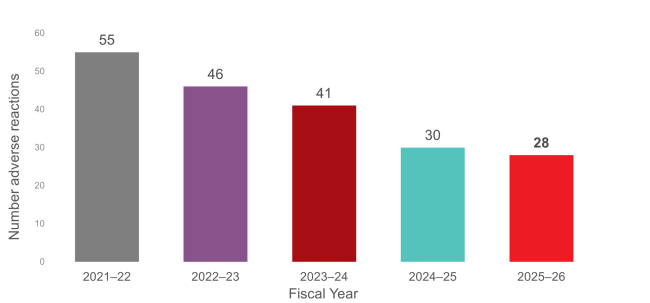
Figure 1: Total reportable† adverse reactions reported to Canadian Blood Services for the last five fiscal years.
† Reportable is defined as reportable to Health Canada by Canadian Blood Services, as determined by the Blood Regulations.
Image
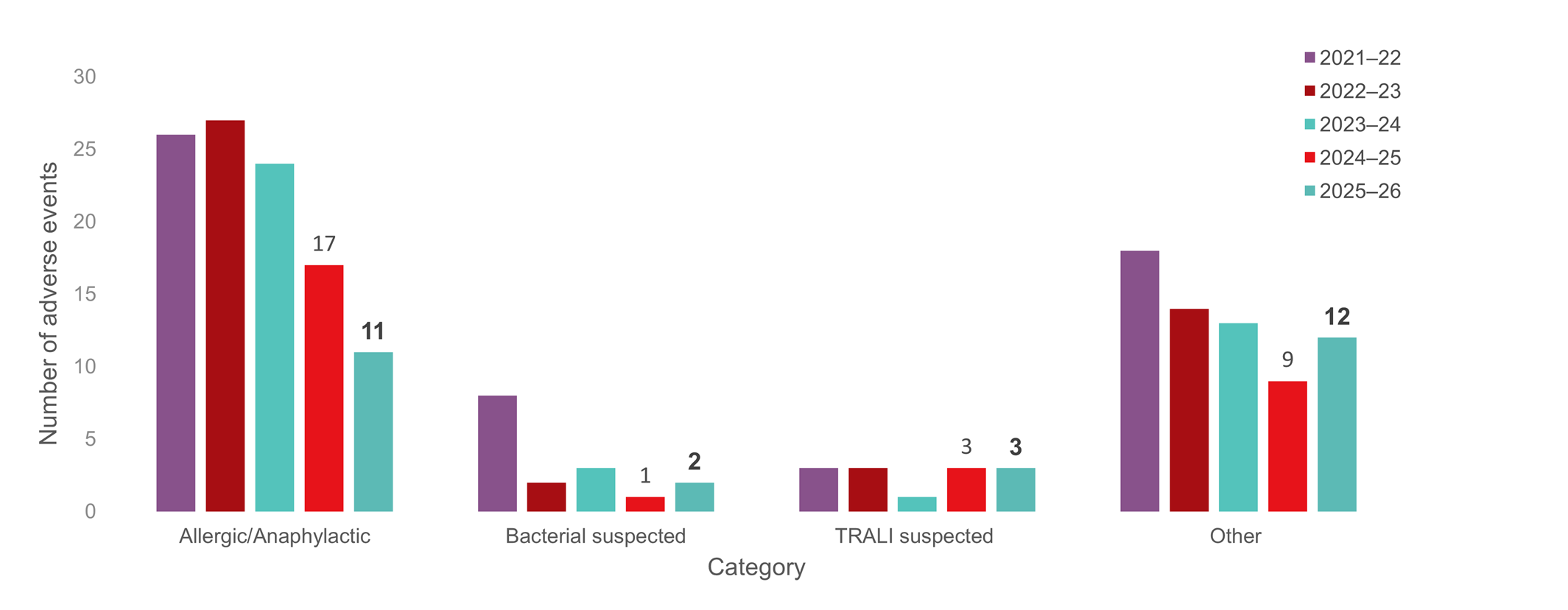
Figure 2: Reportable adverse reactions reported to Canadian Blood Services by category for the last five fiscal years.
Note: The "Other" category includes transfusion adverse reactions that were originally reported from Canadian Blood Services to Health Canada (namely suspected TRALIs), but following further investigation were reclassified as a reaction that is not reportable to Health Canada as per the Blood Regulations (due to underlying illness, TACO, etc. (TRALI=transfusion-related acute lung injury, TACO=transfusion associated circulatory overload).
Data on adverse transfusion reactions reported to Canadian Blood Services from 2013–2014 to 2025–2026, can be viewed in this downloadable Excel file:
51.36 KB
October 22, 2026
Suggested citation
Yan M. Summary of adverse transfusion reactions 2021–2026 [Internet]. Ottawa: Canadian Blood Services; 2026 [cited YYYY MM DD]. Available from: Summary of adverse transfusion reactions 2021–2026 | Professional Education