| Version | Date | Description of change |
|---|---|---|
| 1.0 | September 2011 | Initial version. |
| 2.0 | January 2015 |
Updates to the sections indicated below:
|
| 3.0 | June 2026 |
Modification of logos for Canadian Blood Services (CBS) and Héma-Québec (HQ). Updates to the sections indicated below:
|

Professional Education / Transfusion
Learn.Share.Advance
Canadian Guidelines for the Uniform Labelling of Blood and Blood Components Using ISBT 128
Version: 3.0
Date: June 2026
This document has been edited for publication by:
- Wanda Lefresne, Canadian Blood Services
- Nathalie Marin, Héma-Québec
- Stacey Hayes, Canadian Blood Services
- Kellie Bignell, Canadian Blood Services
Image

Document history
Table of contents
- 1. Preface
- 2. Glossary of Terms
- 3. ISBT 128 Standard: Technical Specification
- 4. ISBT 128 Data Structures
- 5. ISBT 128 Data Identifiers
- 6. ISBT 128 Standard Base Label
- 7. ISBT 128 Blood Component Label
- 8. Description of ISBT 128 Data Structures
- 8.1 Data Structure 001: Donation Identification Number
- 8.2 Data Structure 002: Blood Groups
- 8.3 Data Structure 003: Product Code
- 8.4 Data Structure 005: Expiration Date and Time
- 8.5 Data Structure 007: Collection Date and Time
- 8.6 Data Structure 009: Production Date and Time
- 8.7 Data Structure 010: Special Testing (General)
- 8.8 Data Structure 012: Special Testing: Red Blood Cell Antigens - General
- 8.9 Data Structure 014: Special Testing: Platelet HLA and Platelet-Specific Antigens
- 8.10 Data Structure 017: Container Manufacturer and Catalog Number
- 8.11 Data Structure 018: Container Lot Number
Downloadable version
July 28, 2026
1. Preface
This document delineates the Canadian guidelines for the labelling of blood and blood components using ISBT 128. It is intended to provide necessary information to assist in using ISBT 128 in Canada.
Labelling of blood and blood components by blood operators in Canada align with the ISBT 128 Standard: Technical Specification. That document is the definitive source describing ISBT 128 and should be consulted when implementing and using ISBT 128. The ISBT 128 Standard: Technical Specification is published on the ICCBBA, Inc website (www.ICCBBA.org). Access to ISBT 128 databases is provided to facilities that register with ICCBBA, Inc. Updates will be made available to facilities that maintain their registration through payment of an annual license fee.
There are several options outlined in the ISBT 128 Standard: Technical Specification that are noted as “nationally determined.” This document provides the options selected by the Canadian blood operators, Canadian Blood Services and Héma-Québec, for blood and components produced in Canada.
Other regulatory requirements may also apply for labelling of blood components.
CAUTION: The illustrations throughout this document are not “real”, accurate representations of ISBT 128 labels. The illustrations are not necessarily to scale. The barcodes are representations only and cannot be scanned. Therefore, barcodes should be printed and positioned on labels according to the ISBT 128 Standard: Technical Specification.
2. Glossary of Terms
| Term | Description |
|---|---|
| Attribute | Attributes provide additional information about a blood component. They are categorized as “Core Conditions” and “Other Attributes” groups. |
| Autologous | Blood collected from the intended recipient |
| Base Label | The label applied by the manufacturer to: (1) primary and satellite containers for the collection of Whole Blood; (2) apheresis collection containers; and (3) transfer containers |
| Core Conditions | The anticoagulant and/or additive, nominal collection volume and storage temperature requirements for a blood component |
| Data Content | The characters in a data structure that encode the information for which the data structure is named. The data content does not include the data identifiers |
| Data Identifier | The first two characters in a data structure that identify the data structure. These will always be present when the data structure is used as a barcode, but may be omitted when the data structure is used in situations in which the data structure identity is unambiguously and explicitly defined. |
| Directed |
A unit collected from a donor who presents to the collecting facility at the request of another person to provide product to be used by that person. Note: Héma-Québec no longer collects this type of donation, but frozen products remain in inventory. |
| Donation Number Label | A label bearing the ISBT 128 Donation Identification Number. Produced in sets, these labels are allocated at the point of donation and ensure the unique labelling of all collection containers, record of donation and samples collected from a single donation event. |
| Flag Character | Part of the data content of a data structure used in process control or data transmission checking. Printed in eye- readable format on the label, but distinguished in some manner from the representation of the other data characters. |
| Modifier | A description that relates to the Core Conditions of a blood component and distinguishes it from other members of the same Class (such as Apheresis, Frozen, Frozen Rejuvenated or Washed). |
| Phenotype | The observable expression of the genes inherited by a person that reflects the biological activity of the genes. In ISBT 128 coding of test results, the term phenotype includes predicted phenotypes based on genotyping where there is evidence in the literature to support such a prediction. |
3. ISBT 128 Standard: Technical Specification
The ISBT 128 Standard: Technical Specification:
- describes the layout for a blood component label
- defines the data identifiers for barcodes used in the transfusion medicine environment
- defines the data structures that carry information, i.e., how a particular barcode will be recognized by a reader, how many characters there are, and whether the characters are letters, numbers or both
- includes tables that define how complex barcodes should be translated, such as ABO/Rh Blood Groups and Type of Donation or Collection
- defines technical details for the barcode itself, such as the width of the narrowest bars and the minimum height of the bars
- describes the variation made in Code 128 to support specialized “concatenation” for linear barcodes
- defines technical details for the use of a 2D barcode that can replace different linear barcodes on a label.
4. ISBT 128 Data Structures
Data structures define the way in which information is presented in ISBT 128. Each data structure consists of data identifiers and data content. These data structures can be incorporated into many different information delivery systems including linear barcodes, electronic messages, 2-D barcodes and radio frequency ID tags.
Where an ISBT 128 data structure is presented within a Code 128 barcode the data characters are printed in eye-readable format immediately beneath the barcode.
The ISBT 128 data structures of the Code 128 barcodes appearing on labels of blood components produced in Canada are listed in Table 1. Table 2 lists the ISBT 128 data structures that may be visible on the container base label. Each of these data structures are described in subsequent sections of this document.
Refer to the ISBT 128 Standard: Technical Specification for a description of all ISBT 128 data structures.
Table 1: Data Structures Used on Blood Component Labels in Canada
| Data Structure | Barcode |
|---|---|
| 001 | Donation Identification Number |
| 002 | Blood Group |
| 003 | Product Code |
| 005 | Expiration Date and Time |
| 007 | Collection Date and Time |
| 009 | Production Date and Time |
| 010 | Special Testing: General |
| 012 | Special Testing: Red Blood Cell Antigens – General |
| 014 | Special Testing: Platelet HLA and Platelet-Specific Antigens |
Table 2: Data Structures for Container Base Labels
| Data Structure | Barcode |
|---|---|
| 017 | Container Manufacturer and Catalog Number |
| 018 | Container Lot Number |
5. ISBT 128 Data Identifiers
Data identifiers define the type of information the barcode contains; for example, the second character distinguishes an ABO/Rh barcode from a Product Code barcode (e.g., the two characters “=%” at the beginning of a barcode indicate that the barcode carries information about the ABO/Rh Blood Groups whereas “=<” means a Product Code barcode).
Each barcode structure on a blood component label will begin with two data identifier characters. The exception, for the Donation Identification Number is that the second data identifier character, for this data structure only, is also the first character of the data content.
The first character will always be “=” or “&.” By international agreement (see the ISBT 128 Standard: Technical Specification) these characters are reserved to mean “this barcode specifies an ISBT 128 data structure.”
Refer to Table 3 for the list of data identifiers associated with the barcodes appearing on labels of blood components produced in Canada. Refer to Table 4 for data identifiers that are associated with the barcodes appearing on container base labels
Table 3: Data Identifiers Used on Blood Component Labels in Canada
|
Data Identifier |
Barcode |
|---|---|
|
=α |
Donation Identification Number |
|
=% |
Blood Group |
|
=< |
Product Code |
|
&> |
Expiration Date & Time |
|
&* |
Collection Date & Time |
|
&} |
Production Date & Time |
|
&( |
Special Testing: General |
|
=\ |
Special Testing: Red Blood Cell Antigens – General |
|
&{ |
Special Testing: Platelet HLA and Platelet-Specific Antigens |
Table 4: Data Identifiers Used on Base Labels
|
Data Identifier |
Barcode |
|---|---|
|
=) |
Container Manufacturer and Catalog Number |
|
&) |
Container Lot Number |
6. ISBT 128 Standard Base Label
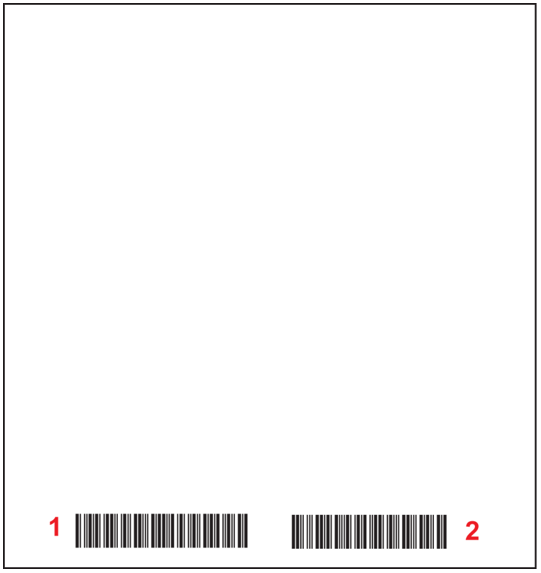
Blood containers are labelled with a base label by the manufacturer of the container. The standard ISBT 128 base label is 100 (± 2) mm by 106 (± 2) mm and carries the two manufacturer’s information barcodes in the position shown in Figure 1:
- Container Manufacturer and Catalog Number (Data Structure 017) (barcode 1);
- Container Lot Number (Data Structure 018) (barcode 2).
Refer to the ISBT 128 Standard: Technical Specification for a description of the data structures for these two barcodes.
One or both of the container manufacturer’s information barcodes may be covered by final labelling. It is preferable that the eye-readable text remain visible after the application of the final component label.
Image
7. ISBT 128 Blood Component Label
The ISBT 128 blood component label is 100 (± 2) mm by 100 (± 2) mm. The label is divided into four quadrants of equal size 50 (±1) mm wide by 50 (±1) mm long.
Regardless of site of collection worldwide, the barcodes should be placed in the same relative positions. The ISBT 128 Standard: Technical Specification defines the placement of the barcodes.
Placement of the barcodes present on labels of blood components produced in Canada is shown in Figure 2:
|
Barcode # |
Information Contained |
Data Structure |
|---|---|---|
|
1 |
Donation Identification Number |
001 |
|
2 |
ABO/Rh Blood Groups, Type of Donation or Collection Information |
002 |
|
3 |
Collection Date and Time |
007 |
|
Production Date and Time |
009 |
|
|
4 |
Product Code, Type of Donation or Collection, Information regarding division of the product |
003 |
|
5 |
Expiration Date and Time |
005 |
|
6 |
Special Testing (when applicable) |
010, 012 or 014 |
Image
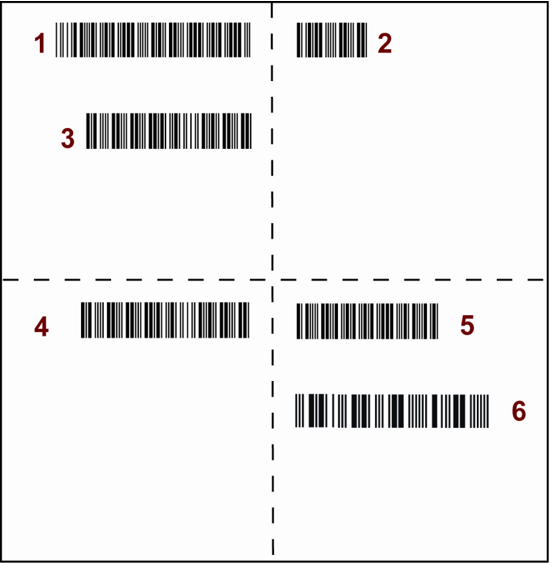
Process control can be enhanced through the use of concatenation (reading of two or more barcodes as if they were a single barcode). For this reason, the Donation Identification Number and ABO/Rh Blood Group barcodes have been positioned on the label to facilitate a single scanning motion. The Product Code and Expiration Date and Time barcodes are similarly aligned.
With the exception of the Donation Identification Number, for which the eye-readable information is presented in a specialized way, the data characters in the barcode are printed immediately below the symbol.
The eye-readable representation of the interpreted barcoded information (called barcode text in this document) and any other information on the label (called additional label text in this document) is defined by each blood operator to meet its own requirements.
8. Description of the ISBT 128 Data Structures
8.1 Data Structure 001: Donation Identification Number
The barcode data structure for the donation number (Data Structure 001) is comprised of 15 data characters (plus the data identifier) as shown below.
Note: This is the only data structure where the second character of the data identifier is part of the data content
|
=αppppyynnnnnnff |
|
|---|---|
|
= |
Data Identifier (first character) |
|
αpppp |
Facility Identification Number (FIN) Note: α is the second data identifier character. |
|
yy |
Last 2 digits of the year of collection Note: To cut down on wastage, it is permissible to use Donation Number labels for up to one month in the year before, and one month in the year after, the year shown on the label. |
|
nnnnnn |
Serial Number |
|
ff |
Flag Characters (NOT part of Donation Identification Number) |
This data structure provides for the unique identification of any donation or collection worldwide for a one hundred year period.
A complete list of registered facilities can be found on the ICCBBA web site.
Manual Entry Check Character
An additional manual entry check character (not the same character integral to every Code 128 barcode) will be printed, enclosed in a box, to the right of the Donation Identification Number (see Figure 3). This check character should be used to ensure the accuracy of keyboard data entry when supported by the appropriate computer software.
Image
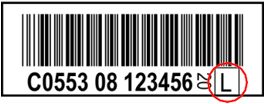
This check character is calculated on the first 13 data characters of the donation number, excluding the flag characters (i.e. αppppyynnnnnn). The ISO modulo 37,2 method is used to compute this check character. (For further information, see ISBT 128 Technical Specification, Appendix A.)
Flag characters
Flag characters are the last two characters of the Donation Identification Number data structure. They are not part of the Donation Identification Number itself. Flag characters are used in process control by the blood operators. Refer to Table 5 for a list of flag characters used in process control by Canadian blood operators. When printed in eye-readable format on labels of blood components these flag characters will be rotated 90 degrees.
Table 5: Flag Characters Used for Process Control in Canada
|
Flag Characters |
Description |
Location |
|---|---|---|
|
20 |
Flag characters that appear on the Donation Number Label applied to blood containers at time of collection to identify the donation. Additional Donation Number Labels may be applied to the back of the container. |
Donation Number Labels |
|
21 |
Flag characters that are printed on the ISBT 128 label at initial labelling. |
ISBT 128 label |
|
22 |
Flag characters that are printed on the ISBT 128 labels of components that have been transformed (e.g. irradiated, washed, etc). |
ISBT 128 label |
| 23 | Flag characters that appear on the Work in Progress label during preparation of the pool (HQ only). | Pool label |
| 35 | Flag characters appearing on labels of components that have been manually rejected as not suitable for transfusion or further manufacturing. | Reject label |
| 00 | The default flag characters (00) will appear in any place where the flag characters have not been defined. |
|
For further information regarding definition of additional flag characters refer to Table RT004 - Donation Identification Number Flag Digits in the ISBT 128 Standard: Technical Specification.
8.2 Data Structure 002: Blood Groups
This data structure provides the coding for the blood groups (ABO/Rh), Rh and Kell phenotypes and type of donation. Its structure is shown below:
|
=%ggre |
|
|---|---|
|
=% |
Data Identifiers |
|
gg |
ABO & Rh blood group and type of donation |
|
r |
Rh, Kell phenotype (optional) Note: In Canada these phenotypes are not coded in this data structure, so this value is always set to 0 (zero) |
|
e |
Reserved for future use. Value always set to 0 (zero). |
Refer to Appendix 1 for a list of ABO/Rh blood group and donation type codes used in Canada.
Data Structure 002, Table RT006 - Special Messages is not encoded in the Blood Groups data structure by either Héma-Québec or Canadian Blood Services.
Data Structure 002, Table RT007 - Rh, Kell, and Mia/Mur Phenotypes is not used by either Héma-Québec or Canadian Blood Services.
8.3 Data Structure 003: Product Code
The eight-digit product code data structure includes donation type and allows for definition of additional information including component divisions/splits. The structure is shown below:
|
=<α0000tds |
|
|---|---|
|
=< |
Data identifiers |
|
α0000 |
Product code Note: α is E or F for blood components |
|
t |
Donation type (e.g. Volunteer, Directed) |
|
d |
First level divisions |
|
s |
Second level divisions |
The first five (5) digits come from the ICCBBA database and are the ‘core’ product code which defines
- Core conditions – e.g. anticoagulant, volume, storage conditions
- Component Class – e.g. Red Blood Cells, Platelets
- Modifiers – e.g. washed, thawed
- Attributes – e.g. irradiated, residual white count, low platelet count
The 6th digit defines the donation type:
| V | Volunteer Donor (see Note 1) |
| 1 | Autologous Use Only |
| 2 | Directed Use Only (Héma-Québec only) |
| X | Autologous Biohazard |
| A | Autologous Collection eligible for crossover (Héma-Québec only) |
Note: Volunteer homologous (allogeneic) donation is the Canadian default donation type.
The 7th digit defines a division/split from the original component (e.g. A0, B0) and the 8th digit defines a division/split from the first divided/split component (e.g. Ba, Bb, Bc).
The ISBT 128 Product Code Database is maintained by ICCBBA. All blood components distributed nationally/internationally must have a standard ISBT 128 product code.
There are no international codes in the ISBT 128 Product Code Database for “in process” components (e.g. first stage of cryoprecipitate production). A set of codes (A0000 – D9999) has been reserved for internal blood agency/facility use for labelling “in-process” components. These codes should not appear on the final label of the blood component. However, components imported from blood operators outside of Canada may be managed by using generic product codes assigned from the “A” series (Héma-Québec) or “B” series (Canadian Blood Services) which are reserved for national blood agency use.
Canadian Blood Services and Héma-Québec share the list of these national codes to avoid conflict in the use of these codes.
Canadian Blood Services and Héma-Québec maintain and provide a list of the product codes used in Canada to the hospitals that they service.
8.4 Data Structure 005: Expiration Date and Time
Data structure 005 provides the coding for the expiration date and time of the component. The expiration date and time appears on all components.
|
&>cyyjjjhhmm |
|
|---|---|
|
&> |
Data identifiers |
|
c |
Century in which component expires |
|
yy |
Year within the century in which component expires |
|
jjj |
Julian (Ordinal) day of the year on which component expires |
|
hh |
Hour at which component expires (00 to 23) |
|
mm |
Minute at which component expires (00 to 59) |
Note: For all the products that have a shelf life calculated in days, the expiration time is by default 23:59.
8.5 Data Structure 007: Collection Date and Time
Data structure 007 provides the coding for the collection date and time of the component. The collection date and time appears on all components except for Pooled Platelets.
|
&*cyyjjjhhmm |
|
|---|---|
|
&* |
Data identifiers |
|
c |
Century in which component was collected |
|
yy |
Year within the century in which component was collected |
|
jjj |
Julian (Ordinal) day of the year on which component was collected |
|
hh |
Hour at which component was collected (00 to 23) |
|
mm |
Minute at which component was collected (00 to 59) |
8.6 Data Structure 009: Production Date and Time
Data structure 009 provides the coding for the production date and time of the component. The production date and time appears only on Pooled Platelet components.
|
&}cyyjjjhhmm |
|
|---|---|
|
&} |
Data identifiers |
|
c |
Century in which component was produced |
|
yy |
Year within the century in which component was produced |
|
jjj |
Julian (Ordinal) day of the year on which component was produced |
|
hh |
Hour at which component was produced (00 to 23) |
|
mm |
Minute at which component was produced (00 to 59) |
8.7 Data Structure 010: Special Testing (General)
The data content string for data structure 010 Special Testing (General) is encoded and interpreted with reference to the Special Testing database table that is published and maintained by ICCBBA.
|
&(zzzzz |
|
|---|---|
|
&( |
Data identifiers |
|
zzzzz |
5-digit alphanumeric data content string (A-Z;0-9) |
The Special Testing (General) data structure indicates special characteristics of a component. In Canada the following special testing codes are used:
| N0000 | No special ISBT 128 tests |
| N0003 | IgA Deficient |
| N0008 | CMV Seronegative (Anti-CMV negative) |
| N0043 | IgA Deficient, CMV Seronegative (Anti-CMV Negative) |
| N0124 | Low Anti-A/B (Canadian Blood Services only) |
This data structure will be found on labels of plasma and pooled platelet components produced by Canadian Blood Services and only on labels of plasma components produced by Héma-Québec.
8.8 Data Structure 012: Special Testing: Red Blood Cell Antigens - General
The data content string for data structure 012 Special Testing: Red Blood Cell Antigens – General is encoded and interpreted with reference to Tables RT009 and RT011 of the ISBT 128 Standard: Technical Specification.
|
=\aaaaaaaaaaaaaaaaii |
|
|---|---|
|
=\ |
Data identifiers |
|
aaaaaaaaaaaaaaaaii |
18-character data content string (0-9) |
The Special Testing: Red Blood Cell Antigens – General data structure encodes red blood cell antigens typing and CMV antibody status. This data structure will be found on labels of whole blood and red blood cell components produced by Canadian Blood Services and Héma-Québec.
Rh antigens are encoded individually using positions 14, 15 and/or 16 and value of column 1 will be set to 9 (no information)
If additional red cell antigen testing has been performed but cannot be encoded in the barcode structure, the information may appear on the label in eye-readable form only.
8.9 Data Structure 014: Special Testing: Platelet HLA and Platelet- Specific Antigens
The data content string for data structure 014 Special Testing: Platelet HLA and Platelet-Specific Antigens is encoded and interpreted with reference to Tables RT013, RT014 and RT044 of the ISBT 128 Standard: Technical Specification.
|
&{AAAABBBBCCCCCCCCDE |
|
|---|---|
|
&{ |
Data identifiers |
|
AAAA |
Specifies HLA-A antigens and is encoded and interpreted according to Table RT013. Two AA values shall be encoded, followed by two BB values. |
|
BBBB |
Specifies HLA-B antigens and is encoded and interpreted according to Table RT013. |
|
CCCCCCCC |
Specifies platelet-specific antigens, IgA antigen and CMV antibody status and is encoded and interpreted according to Table RT014. |
|
D |
Reserved for future use. A default value of 00 (zero, zero) is used. |
|
E |
Specifies information about high titered antibodies to A and B antigens and is encoded and interpreted according to Table RT044. |
This data structure provides information regarding HLA and HPA phenotypes, CMV antibody status, IgA status and information regarding high titered antibodies to A and B antigens for platelet products.
Note 1: The HLA phenotypes appear in eye readable format only and are not encoded in the Special Testing barcode. For Canadian Blood Services only, the HPA phenotypes also appear in eye readable format only and are not encoded in the Special Testing barcode.
Note 2: Information regarding high titered antibodies to A and B antigens is displayed on the label by “T.E.N.D./H.T.N.D.” (Héma-Québec) or “Low Anti-A/B” (Canadian Blood Services) which means High Titre Not Detected.
8.10 Data Structure 017: Container Manufacturer and Catalog Number
Data structure 017 provides coding to specify the manufacturer and catalog number of the container set and the identifying character(s) of the individual container(s) in the set. This data structure is not normally visible on the labelled blood component; however the eye-readable barcode text may be visible.
|
=)bqqwwwwwww |
|
|---|---|
|
=) |
Data identifiers |
|
b |
The container identification character in a container or transfer set. The value of b is set as follows:
|
|
|
Specifies the identity of the container set manufacturer and is encoded and interpreted from the Manufacturer Identifier Codes table. Refer to Table RT015 on the ICCBBA website (ICCBBA.org). |
|
wwwwwww |
The manufacturer’s catalog number. This must be interpreted from information provided by the manufacturer. |
8.11 Data Structure 018: Container Lot Number
Data structure 018 is a 10-character alphanumeric data string that encodes the manufacturer’s lot number for the container set. This data structure is not normally visible on the labelled blood component, however the eye-readable barcode text may be visible.
|
&)xxxxxxxxxx |
|
|---|---|
|
&) |
Data identifiers |
|
xxxxxxxxxx |
Container lot number (alphanumeric A–Z; a–z; 0–9) |
9. Uniform Labelling Using ISBT 128
9.1 Barcodes and Barcode Text
The layout of the barcodes on collection, satellite or transfer containers will conform to the quadrant design as outlined in the ISBT 128 Standard: Technical Specification:
Upper Left: Donation Identification Number (see Note) Collection or Production Date and Time
Upper Right: ABO/Rh Blood Groups and Type of Donation/Intended Use Lower Left: Product Code
Lower Right: Expiration Date and Time
Special Testing
Note: In addition to the final ISBT 128 label, the Donation Number Label applied at collection is normally present on the component. This number is present for label control in the blood centre.
The eye-readable representation of the barcode data content will appear directly beneath each barcode. The eye-readable text will include all of the data characters contained in the barcode symbol but will not include the data identifier (except for the Donation Identification Number) or start/stop characters.
The interpretation of the barcode content (e.g. blood group, collection and expiry date and time, special testing) will appear in eye-readable format below the barcode.
Dates will be printed in the format day month year. The day will be numerical, the month alphabetical, using a three-letter abbreviation. Refer to Table 6 for the month abbreviations used in Canada. The year will be a four-digit numerical representation.
Table 6: Month Abbreviations Used in Canada
| Canadian Blood Services | JAN | FEB | MAR | APR | MAY | JUN | JUL | AUG | SEP | OCT | NOV | DEC |
|---|---|---|---|---|---|---|---|---|---|---|---|---|
| Héma-Québec | JAN | FEV | MAR | AVR | MAI | JUN | JUL | AOU | SEP | OCT | NOV | DEC |
Times will be printed based on a twenty-four-hour clock with a colon placed between the hours and minutes.
9.2 Component Description
Additional label text providing a description of the component will appear in the bottom left quadrant below the product code barcode.
The order of component information presented on the labels varies between Canadian Blood Services and Héma-Québec. Refer to the label examples shown in Sections 9.4 and 9.5. The component description text (including font and font sizes) in these label examples may not represent the most current label.
9.3 Eye-readable Red Cell Phenotypes
Rules for printing of the eye-readable red cell phenotypes on the final label are as shown below:
|
Font type |
Description |
Comments |
|---|---|---|
|
Regular font, Not underlined |
One determination on a previous donation |
|
|
Regular font, Underlined |
One determination made on the current donation |
|
|
Bold font, Not underlined |
Two determinations made on two previous donations |
|
|
Bold font, Underlined |
Two determinations, the second being on the current donation. |
|
|
Asterisk (*) following antigen |
Indicates phenotype predicted by genotype testing |
Héma-Québec only |
Note 1: A phenotype may appear in eye-readable text that is not encoded in the Special Testing barcode.
Note 2: The ellipsis “…” at the end of the eye-readable phenotype list indicates there was insufficient room to print all known phenotypes on the component label.
Note 3: A positive phenotype may be encoded in the Special Testing barcode, however, it will not be present in the eye-readable text. (Canadian Blood Services only).
9.4 Canadian Blood Services Labels
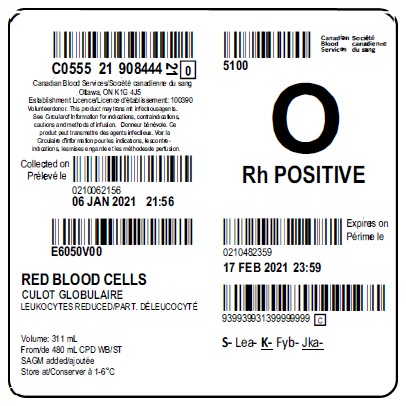
Canadian Blood Services uses the standard 100 mm by 100 mm ISBT 128 Blood Component Label for all blood components. An example of a label for a Red Blood Cell component is shown in Figure 4.
Image
9.4.1 Components for Transfusion
Component description information will be presented in the lower left portion of the label of components for transfusion in the order described below:
Image
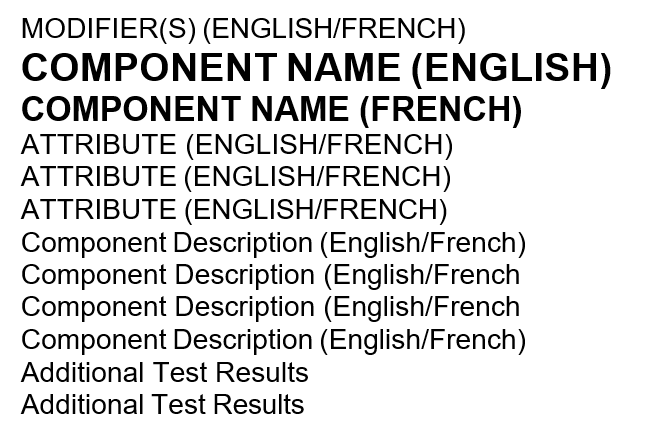
- Modifiers include:
- Apheresis
- Washed
- Extra Washed
- Frozen
- Deglycerolized
- Cryosupernatant
- Attributes, when applicable, will normally be presented in the following order:
- Leukoreduction
- Low Volume / Low Count
- Psoralen-Treated
- Divided
- Irradiation
- Other descriptors (e.g. container number)
- Component Description will normally be presented in the following order:
- Component Volume
- Nominal collection volume/anti-coagulant
- Additive solution
- Storage Conditions
- Additional test results include:
- Red Cell Antibody
- Indication of Untested status for components distributed by Emergency Release and Untested Autologous donations
- Indication of Subsequent Testing for Autologous donations
- Volume of anticoagulant present in apheresis plasma/platelet components
9.4.2 Recovered Plasma and Cryosupernatant Plasma for Further Manufacturing
Component description information will be presented in the lower left portion of the label of components for further manufacturing in the order described below:
Image

The list of tests performed on the donation is printed in the lower right quadrant of the label.
9.4.3 Source Plasma for Further Manufacturing
Component description information will be presented in the lower left portion of the Source Plasma label in the order described below:
Image
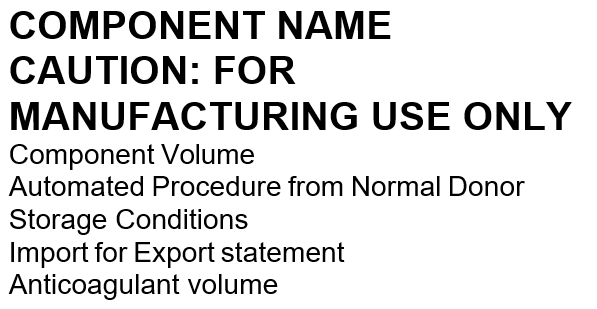
The list of tests performed on the donation is printed in the lower right quadrant of the label.
9.5 Héma-Québec Labels
Héma-Québec uses the standard 100 mm by 100 mm ISBT 128 Blood Component Label for all blood components. An example of a label for a Red Blood Cell component is shown in Figure 5.
Image
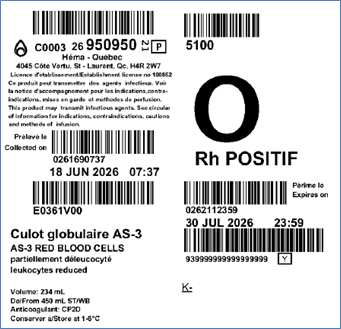
9.5.1 Components for Transfusion
Because of the need for bilingual labels (French and English) with prevalence for French, the general principles for printing can be slightly different than what is suggested in the ISBT 128 documentation. Component description information will be presented in the lower left portion of the label of components for transfusion in the order described below:
Image
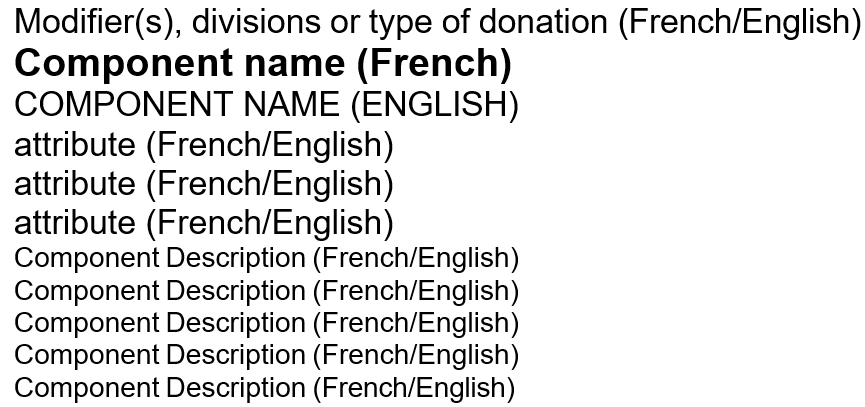
- Modifier(s), divisions or type of donation include:
- Apheresis
- Washed
- Deglycerolized
- Division number
- Designated
- International
- Component name (French and English)
- Additive solutions for red blood cells are associated to the component name
- The following modifiers may be associated to the component name
- Washed
- Deglycerolized
- Frozen
- Component name (English)
- Always printed in capital letters because the font size is smaller than the component name in French
- Attributes, when applicable, will normally be presented in the following order:
- Leukoreduction
- Low Volume
- Irradiation
- Component Description will normally be presented in the following order:
- Component Volume
- Nominal collection volume
- Anticoagulant
- Storage conditions
- Standard Apheresis Platelet Count
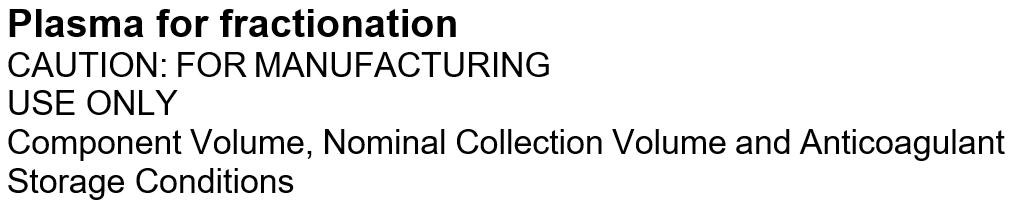
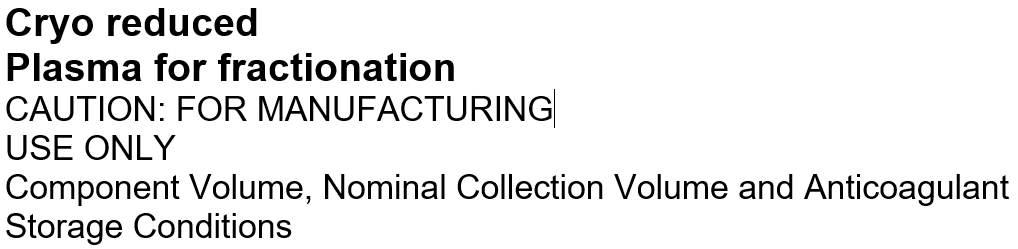
9.5.2 Plasma and Cryo reduced Plasma for fractionation
Component description information will be presented in English only in the lower left portion of the Plasma label in the order described below:
Image
Image
9.5.3 Apheresis Plasma for fractionation
Component description information will be presented in English only in the lower left portion of the Plasma label in the order described below:
Image

Appendix 1: Data Structure 002: Blood Groups
|
ABO and RhD Blood Groups |
Default: Intended Use Not Specified |
Directed Collection Use Only |
For Autologous Use Only |
For Autologous Use Only/ Biohazardous |
Autologous Collection/ Eligible for Crossover |
|---|---|---|---|---|---|
|
O RhD negative |
95 |
91 |
97 |
98 |
96 |
|
O RhD positive |
51 |
47 |
53 |
54 |
52 |
|
A RhD negative |
06 |
02 |
08 |
09 |
07 |
|
A RhD positive |
62 |
58 |
64 |
65 |
63 |
|
B RhD negative |
17 |
13 |
19 |
20 |
18 |
|
B RhD positive |
73 |
69 |
75 |
76 |
74 |
|
AB RhD negative |
28 |
24 |
30 |
31 |
29 |
|
AB RhD positive |
84 |
80 |
86 |
87 |
85 |
|
0 |
55 |
P2 |
P8 |
P9 |
P7 |
|
A |
66 |
A2 |
A8 |
A9 |
A7 |
|
B |
77 |
B2 |
B8 |
B9 |
B7 |
|
AB |
88 |
C2 |
C8 |
C9 |
C7 |
|
para-Bombay, RhD negative |
D6 |
D2 |
D8 |
D9 |
D7 |
|
para-Bombay, RhD positive |
E6 |
E2 |
E8 |
E9 |
E7 |
|
Bombay, RhD negative |
G6 |
G2 |
G8 |
G9 |
G7 |
|
Bombay, RhD positive |
H6 |
H2 |
H8 |
H9 |
H7 |
|
O para-Bombay, RhD negative |
I6 |
I2 |
I8 |
I9 |
I7 |
|
O para-Bombay, RhD positive |
J6 |
J2 |
J8 |
J9 |
J7 |
|
A para-Bombay, RhD negative |
K6 |
K2 |
K8 |
K9 |
K7 |
|
B para-Bombay, RhD negative |
L6 |
L2 |
L8 |
L9 |
L7 |
|
AB para-Bombay, RhD negative |
M6 |
M2 |
M8 |
M9 |
M7 |
|
A para-Bombay, RhD positive |
N6 |
N2 |
N8 |
N9 |
N7 |
|
B para-Bombay, RhD positive |
O6 |
O2 |
O8 |
O9 |
O7 |
|
AB para-Bombay, RhD positive |
Q6 |
Q2 |
Q8 |
Q9 |
Q7 |
Extracted from: ISBT 128 Standard Technical Specification
Table RT005: Data Structure 002: Blood Groups [ABO and RhD], Including Optional Type of Donation or Collection Information